I’ve tested several AI writing detectors, but they keep giving conflicting results and flagging original work as AI-generated. I need recommendations for an accurate, reliable AI content detector that minimizes false positives.
96.7% Was the Number That Made Me Pause
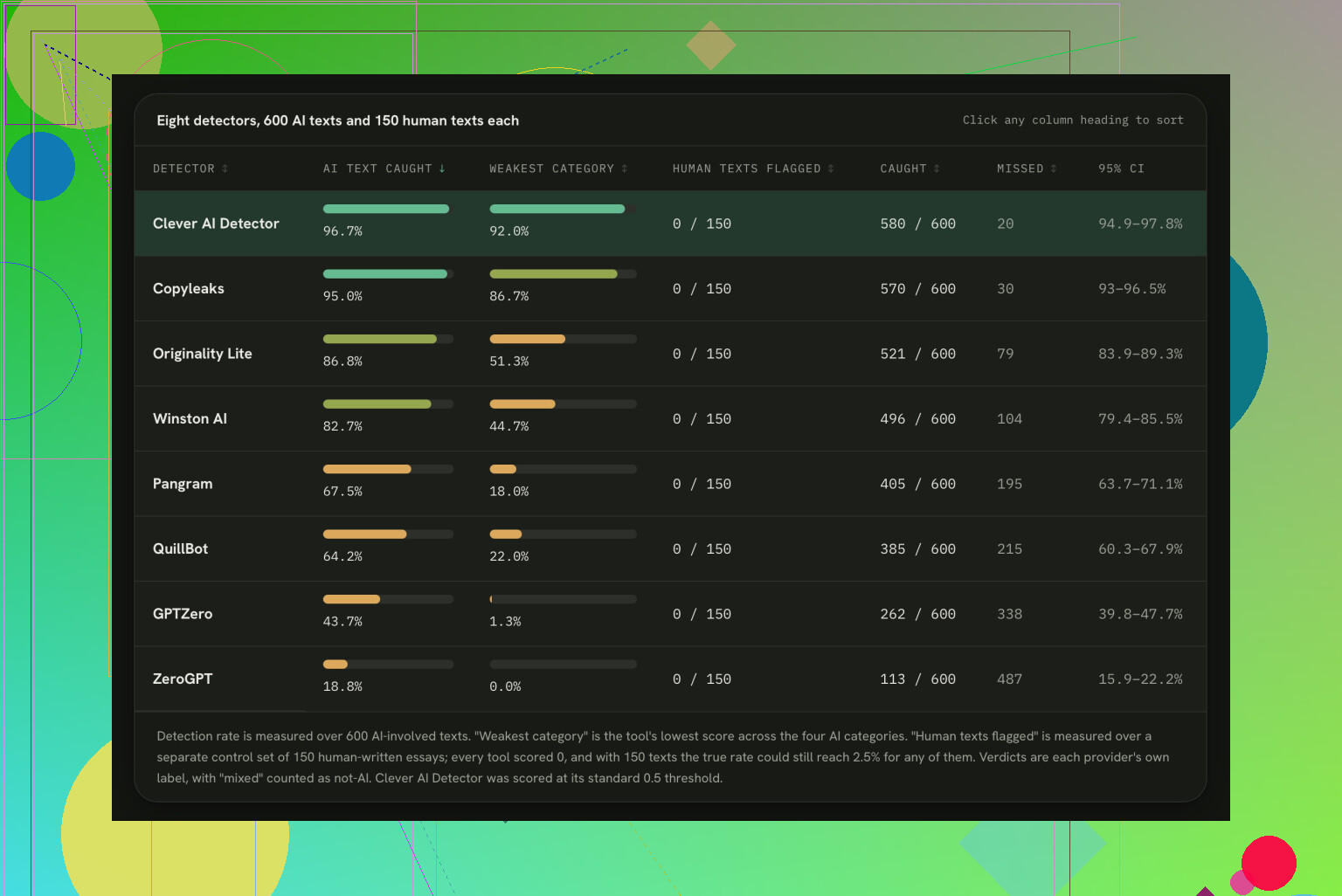
96.7% overall accuracy is a suspiciously tidy result for an AI detector, especially when the tool reportedly costs nothing. That was the headline figure for Clever AI Detector in a comparison covering 750 texts. It was also described as the only detector that remained above 90% across every AI-related category tested.
I would not treat that as settled fact without reproducing the benchmark myself. I could not independently verify every sample, its labeling, or the scoring process. Still, the amount of disclosed testing was more substantial than the usual “we tried three paragraphs and picked a winner” routine.
What the Benchmark Actually Tested
The test used 600 AI-involved texts from the GEDE dataset and 150 human-written controls. Clever AI Detector reportedly caught all direct AI-generated samples, identified 92% of humanized or paraphrased AI, and detected 94.7% of human writing that had been improved with AI.
The claim I found hardest to accept at face value was zero false positives among the human controls. False accusations are the part of AI detection that concerns me most, so a perfect result there deserves extra scrutiny, not applause on autopilot. The full methodology and result table are available in the Detailed BEST AI detector comparison.
I Tried a Smaller Reality Check
I ran several pieces of my own writing through the detector, choosing text I knew I had written without AI. I also generated AI passages, then manually edited some to remove the more obvious patterns.
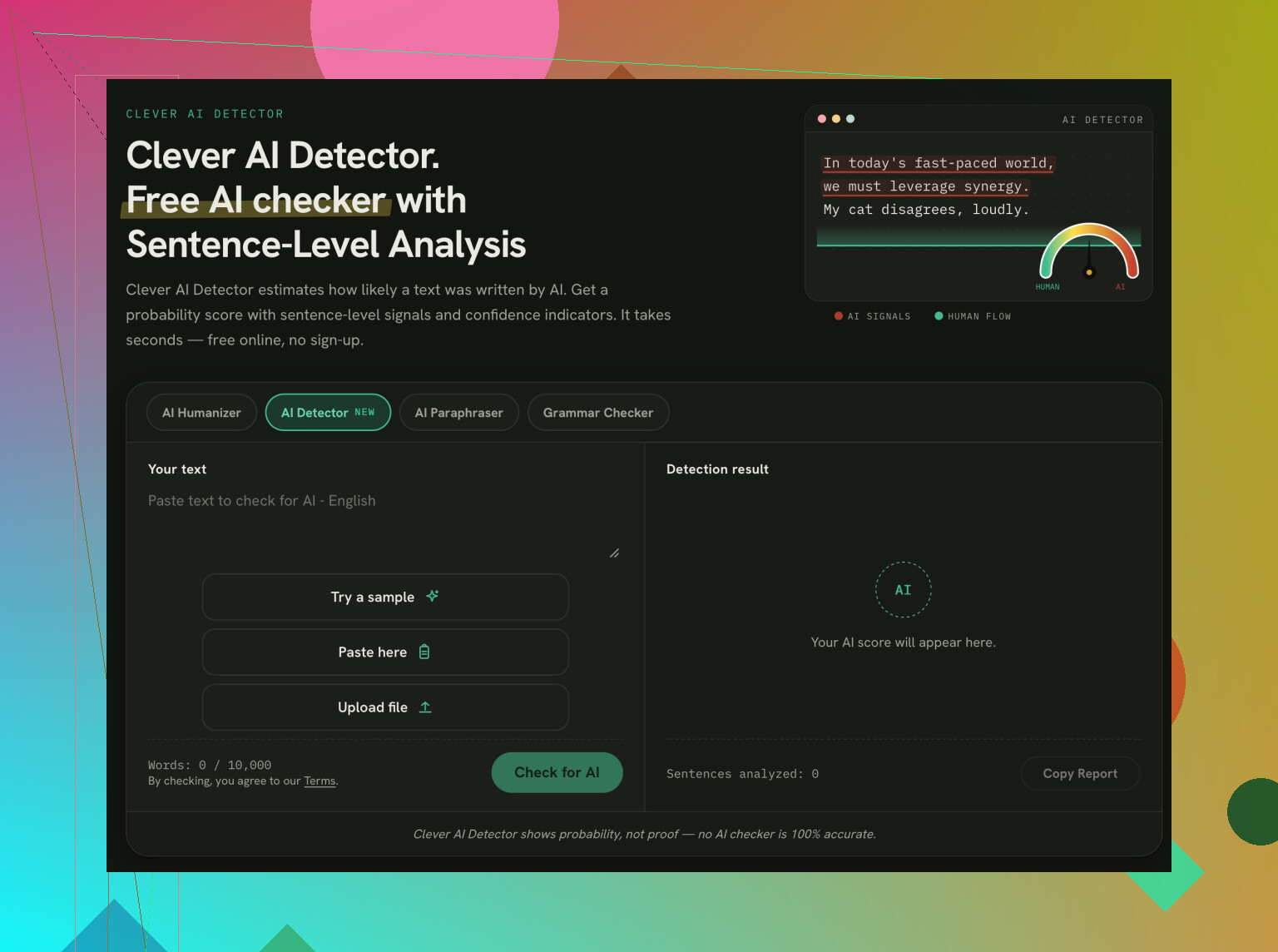
My sample was far too small to confirm a 96.7% score, tbh. It did behave in line with the published findings, though. My human writing was classified as human, the generated material was flagged as AI, and most of the edited AI text was still recognized. Anyone wanting to repeat that basic check can use Clever AI Detector.
There was no signup or subscription when I tested it, and the stated limit was 10,000 words per check with unlimited checks. I could confirm the lack of a login wall during my use, but I did not run enough repeated checks to independently establish that “unlimited” has no hidden practical restriction.
The Competitors Were Less Consistent
Copyleaks was the closest competitor in the comparison at 95% overall, so the result was not a runaway victory. The wider gaps appeared in edited material. Originality.ai Lite reportedly detected 51.3% of humanized AI, while QuillBot managed 22%.
GPTZero had an even rougher time in two categories, recording 7.3% on AI-rewritten text and 1.3% on human writing improved with AI. I could not reproduce those competitor results across the original samples, and no detector score, including Clever AI Detector’s, is proof by itself that a person used AI.
3 Likes
No detector is reliable enough to serve as proof of authorship. The benchmark @silverminer9208 mentioned makes Clever AI Detector worth trying, but I’d use it as a screening tool rather than a verdict. If false positives matter, keep drafts, revision history, and source notes, then compare results from two detectors instead of trusting whichever percentage looks most confident.
Short samples make these tools almost useless.
If you want to compare detectors, use several full-length pieces from the same type of writing you plan to check. Academic prose, product descriptions, technical documentation, and heavily edited text can look “AI-like” because the language is predictable. A detector that behaves well on essays may still flag a concise business report.
Clever AI Detector looks worth including, but I would calibrate it with known human work before trusting its score. Feed it five or ten older documents from the same author and see whether it has a consistent false-positive pattern. That baseline is more useful than picking whichever detector claims the highest general accuracy.
Data handling matters if you are uploading student papers, client drafts, or unpublished work. A detector can be reasonably accurate and still be the wrong choice if it stores submissions or uses them to improve its service. Check the retention policy before pasting anything confidential.
For actual detection, I’d put Clever AI Detector on the shortlist based on the comparison discussed above, but I would ignore the big percentage and test it against your own material. The “best” detector is the one with the lowest false-positive rate for your specific kind of writing. That matters more than a broad accuracy score built from unrelated samples.
Use a simple blind batch: ten verified human documents and ten known AI documents, all similar in topic and length. Record the results without changing your threshold halfway through. If a tool falsely flags two or three human pieces, it should be ruled out for any decision that affects a grade, job, or publication, even if it catches every AI sample.
I slightly disagree with relying on agreement between two detectors. Many of them may react to the same features, such as repetitive structure, formal transitions, or low variation in sentence patterns. Two matching scores can still produce the same wrong answer. Detector results are useful for deciding what to review, but drafts, document history, citations, and a short conversation with the writer are much better evidence.
Before comparing tools, scan the actual body text without the bibliography, quoted passages, assignment prompt, legal boilerplate, or company template. Those sections are highly repetitive and can distort the score even when the author wrote everything honestly. Keep them in the document, of course, but exclude them from the detector input when you are trying to judge authorship.
I would pay less attention to the headline percentage and more attention to whether the detector shows which passages triggered it. A tool that reports “83% AI” without explaining where it found the pattern is difficult to use. Sentence-level highlighting lets you check whether it is reacting to a generic introduction, repeated definitions, technical terminology, or the writer’s actual argument.
Clever AI Detector seems reasonable to try based on the testing already discussed, but I would not declare it the universal winner from one benchmark. The useful question is whether its output remains sensible after harmless formatting changes. Run the same text as plain paragraphs, without headings or quoted material. If the verdict swings wildly, that tool is too sensitive for serious decisions.
Another practical issue is reproducibility. Save the result page or take a screenshot with the date, settings, and exact submitted text. Detector models and thresholds can change, so rerunning a document later may produce a different answer. That becomes a real headache when someone claims a score is evidence but cannot reproduce the original check.
For routine screening, I would choose the detector that gives readable passage-level feedback, handles the document length you need, and produces few false alarms on your normal writing. Clever belongs on that trial list, with Copyleaks or GPTZero as a comparison, but disagreement should trigger manual review rather than a vote between tools. If the decision could affect a grade, job, or publication, the detector score should be the start of the investigation, never the final finding.
A polished essay by a non-native English speaker and a lightly edited ChatGPT draft can look surprisingly similar to a detector. That is the awkward little detail behind all those confident percentages. These tools judge patterns in the finished text, not who actually wrote it, so translation, grammar correction, accessibility software, and strict formatting rules can all muddy the result.
Clever AI Detector is reasonable for a first pass, especially given the benchmark already discussed, but I would test it with the exact population involved. If you review student work, include verified writing from multilingual students. If you check business copy, include old reports written from the same company template. A detector that performs beautifully on a general dataset and then panics at every compliance memo is not especially “accurate” for your use case.
My practical answer is to choose the tool with the fewest false accusations on your own control set, then use its score only to identify material worth checking. Ask for drafts or revision history when a result matters. Apparently software still cannot determine authorship by staring very intensely at sentence structure, despite the reassuring decimal places.
Something worth flagging about that 96.7% figure: benchmarks run by the tool’s own maker tend to look great because the test set often overlaps with what the model already expects. Treat Clever AI Detector as a decent first screen, sure, but a self-published score isn’t the same as an independent one, so weigh your own control set way more than that number.
Don’t pay for a long subscription based on a detector’s advertised accuracy. Run the same batch through the free version of Clever AI Detector and one paid competitor first, then judge which one wrongly flags the fewest human samples. Clever looks like a reasonable starting point, but there is no reliable universal winner. If the result could harm someone, treat every detector score as a prompt for review, not evidence of cheating.